Assumptions are visible, not hidden
Every score starts as Assumed; users upgrade it to Personal estimate or Verified. The system never pretends to know what it cannot know.

A focused service for life-science teams that want to see AI working on their real workflow: commercial intelligence, QARA, forecasting, regulated documents and reporting, before committing to a platform. Useful when a team needs evidence before buying tools, changing workflows or scaling AI internally. Every prototype ships with defined AI limits, human review points and source-linked outputs.
A prototype built for a pharmaceutical distributor evaluating hospital tenders: upload the tender documents and the system extracts lots, scores ROI, portfolio fit, competition and supply feasibility, and produces execution plans, with every number traceable to a source section.
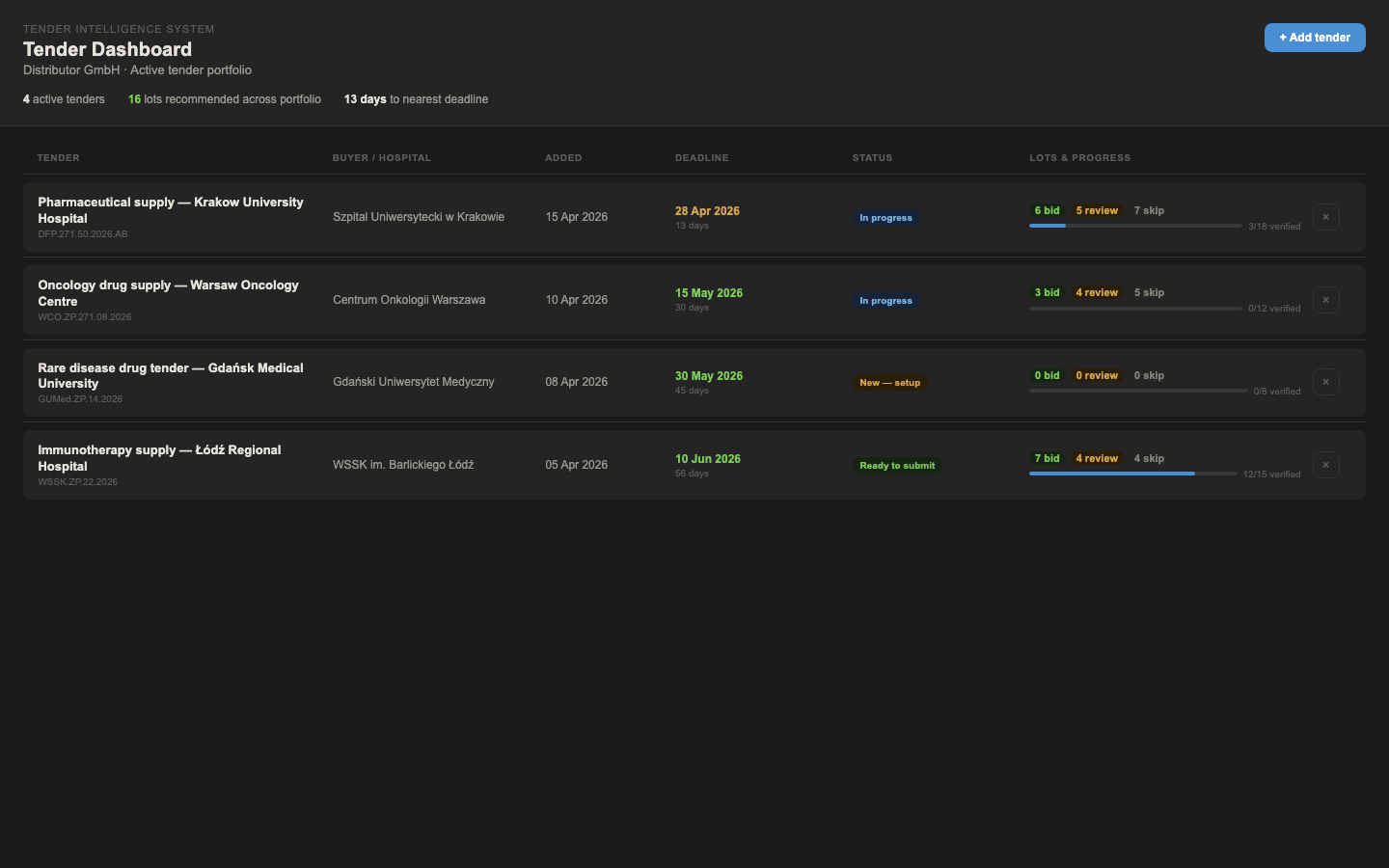
Every score starts as Assumed; users upgrade it to Personal estimate or Verified. The system never pretends to know what it cannot know.
Deadlines, penalties and payment terms link back to the tender section or contract clause they came from, ready for audit.
Open questions are ranked by financial impact, so the team verifies the highest-value lot first.
A prototype like this is typically scoped in the workflow audit and built in weeks, not quarters. AI workflow audit.
New tools fail when they force new processes, checklists and vocabulary. Prototypes are shaped around the team’s existing steps: same documents in, same decision out, just faster and traceable.
In comparable document-writing workflows, Weiser Systems observed approx. 75%+ time saving during internal testing. See the supporting patient-facing materials proof point.
Documents and decision criteria the team already uses.
Extraction, summaries, scoring drafts and open questions.
Assumptions are corrected, estimated or verified.
The rationale is captured with source links.
Scale, adjust or stop based on evidence.
The pilot turns an unclear manual process into a visible operating model: what goes in, what AI may prepare, what must be reviewed and how the decision trail is captured.
Requirements buried in PDFs, scoring in someone’s head, deadlines tracked in email, no record of why a bid decision was made.
The prototype extracts, structures and scores; flags what is assumed vs verified; produces the decision record automatically.
Allowed inputs, forbidden decisions, review stages and audit notes are defined before the build starts.
One workflow, one team, real documents; errors and workload impact captured before any scale decision.
Each prototype is deliberately narrow. It proves whether a controlled AI workflow can reduce manual effort before the team commits to a broader platform or operating model.
Tender and market analysis, opportunity scoring, competitor tracking, structured decision support. The worked example lives here.
Document sweeps, consistency checks, requirement extraction, review preparation and audit-ready trails.
Recurring report assembly, data-to-narrative drafts, variance summaries with source links.
The prototype can prepare analysis, extraction and draft scoring. It does not make the business, quality or regulatory decision. Those stay with the team.
Pull requirements, values and deadlines from documents, each tied to its source section.
Weighted criteria the team defines and can override; no black-box ranking.
Assumed, estimated and verified stages keep human judgement in the loop and visible.
Reports and audit trails generated from the verified state, ready for internal review.
The engagement is designed to avoid uncontrolled automation. A narrow prototype is easier to validate, document and improve before the team decides what should happen next.
Inputs, owners, decisions and data sensitivity.
Data boundaries, forbidden decisions and review responsibilities.
Limited working system on real or safely masked documents.
Real users, captured errors, evidence-based scale decision.
Useful for tender windows, submission cycles and reporting periods where manual extraction consumes expert time and decisions need to remain traceable.
Send one workflow description or example document set. We will assess whether a controlled prototype can reduce manual effort, and what it must never be allowed to decide.