Clinical trial document workflows

Patient-facing trial materials, made easier to control.

A focused service for life-science teams that need AI-assisted support around Informed Consent Forms (ICFs), patient recruitment content, translation handovers, redaction and human review — without losing traceability or accountability.

Scan the service
ForClinical operations, medical writing, regulatory, commercial and patient recruitment teams
Use caseICFs, recruitment and retention materials, translation and redaction workflows
MethodNarrow pilot, mapped controls, source-linked outputs
PrincipleAI supports creation and the workflow. People approve the content.
Practical value - Simplicity

Less manual work, improved workflow.

There's nothing new to learn. Simply upload your documents and let AI handle the repetitive drafting and document assembly. You stay in control of the final review, revisions, and decisions. What once took hundreds of hours and thousands of dollars now takes days - at a fraction of the cost, with the same or improved quality.

Documented results - free pilot to validate on your documents
75%+

Time saved on drafting and revision work.

In testing on suitable document workflows, AI-assisted preparation cut drafting and revision effort by at least 75%.

Efficiency increases with complexity. The more structured and complex the case, the more repeated logic, terminology, formatting and local adaptation work can be reused instead of rebuilt.
The process stays simple and familiar.

01
Source inputs

Protocol, templates, local requirements and client rules.

02
AI-assisted draft

Structured document preparation from approved material.

03
Human review

Qualified reviewers add comments and decisions.

04
Tracked revision

Changes are implemented visibly with rationale.

05
Source check

Revisions are checked against source documents.

Quality improves through the normal review cycle

What changes in practice?

The service turns an unclear document process into a visible operating model: what goes in, what AI may help with, what must be reviewed, and how the decision trail is captured.

Initial ICF compliance and quality approx approx70%

Measured against source files during Weiser Systems testing.

After human reviewer feedback≥90%

Improved after expert comments were incorporated and checked.

Reviewer feedback is checked against the source files. AI-assisted revisions are paired with confirmatory or explanatory comments, plus confidence levels where useful, so reviewers can see what changed and why.

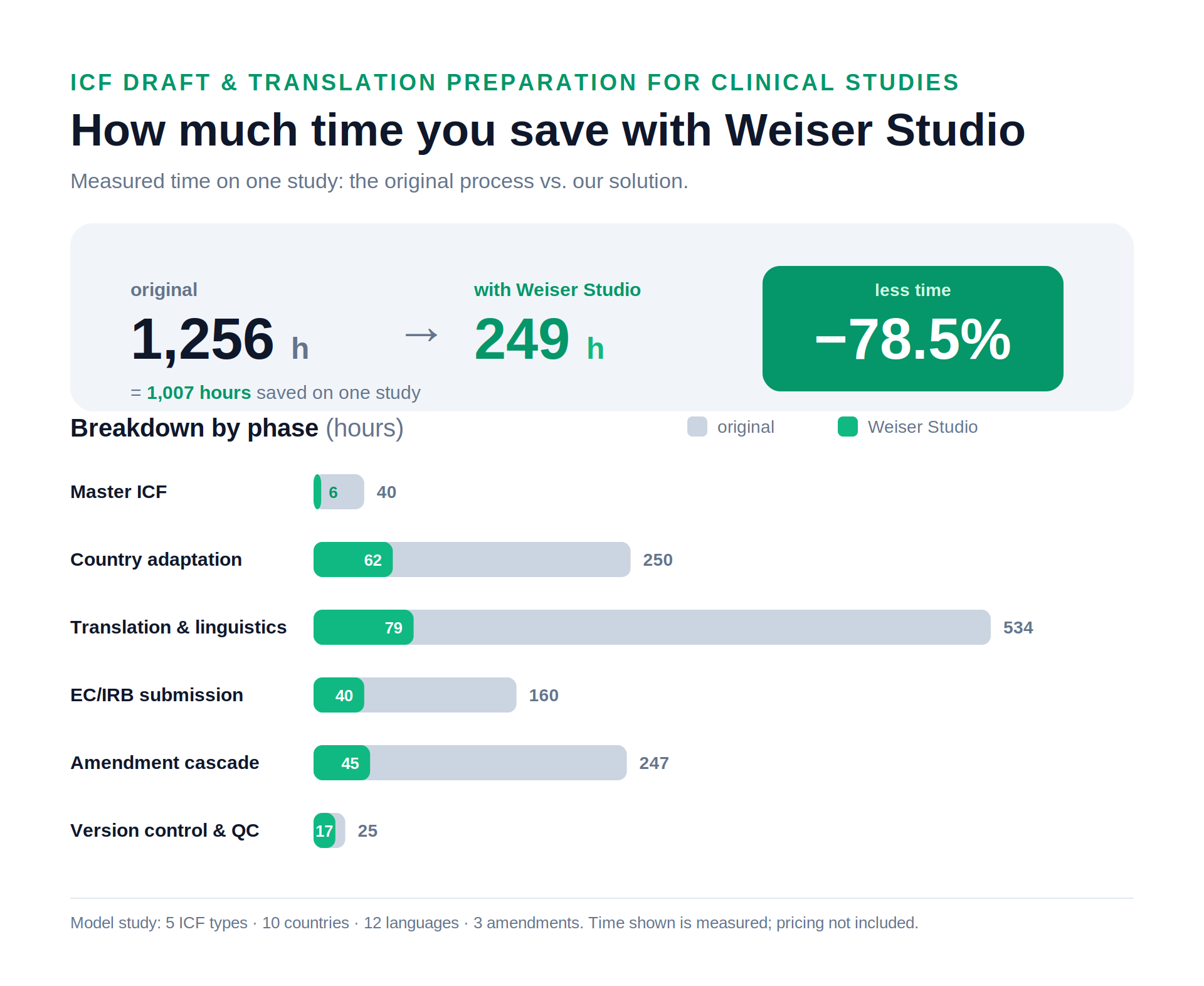
ICF draft and translation preparation time savings model study: original process 1,256 hours, with Weiser Systems 249 hours, 78.5 percent less time
A

Before: scattered review work

Teams compare files manually, track questions across emails, repeat checks, and struggle to see which document changed, why, and who still needs to review it.

B

After: controlled assistance

The workflow assistant prepares structured checks, change summaries, source references and review handovers — while final judgement remains with qualified people.

C

Visible controls

Every AI-supported step is scoped: allowed inputs, forbidden decisions, human review points, acceptance criteria and audit notes are defined before the pilot starts.

D

Measured pilot

The first engagement tests one document family in one context so the team can judge workload impact, errors, usability and whether scaling is justified.

The more complex the document, the greater the efficiency gain tends to be.

Complex clinical documents often repeat the same structures, terms, review patterns and country-specific adaptation rules. Once mapped, those patterns can support faster, more consistent document work.

Outputs are prepared for real review work.

The goal is not a loose AI text. The output is prepared so a team can review, challenge and approve it using familiar document practices.

Tracked changesVisible edits and revisions for reviewer control.
References and explanatory notesSource links, rationale and comments where the reviewer needs context.
Checks against source documentsChanges are checked against approved source material before handover.
Service focus

High-volume materials. High-sensitivity review.

Patient-facing trial documents often move through many hands: study teams, reviewers, legal, privacy and local approval processes. The opportunity is not “let AI write it”. The opportunity is to make the workflow easier to see, check and hand over.

Informed Consent

Main (Adult, Parent/Guardian or Legally Acceptable Representative), Pregnancy and Newborn Follow-Up, ancillary consents and data privacy consents/authorisations — with careful versioning, review considerations and local adaptation support.

Patient Recruitment

Common examples include: study posters, leaflets, website content, pre-screening questionnaires and doctor-to-patient letters or emails. Recruitment content and materials can be tailored to meet client specifications with the trial population in mind, supporting the work needed to achieve target recruitment numbers.

Retention and site support

Common examples include: study guides, visit reminders, patient ID cards, physician referral materials and eligibility criteria checklists. Retention and site support content can be tailored to the trial’s needs, helping support patient and site engagement throughout the study.

Informed Consent workflow detail

Activity

AI can assist end-to-end ICF creation, from Global Master ICF development through implementation of country requirements for local adaptation.

Revision support

AI can also support ICF revision following expected events that affect consent language, including protocol amendments and local submission queries.

Why AI for ICFs?
  • ICFs are often the most challenging and time-consuming patient-facing clinical trial documents to develop.
  • Complex local requirements must be carefully considered and applied consistently for regulatory compliance with simultaneous consideration for client specifications and language requirements.
  • Scattered reviews without clear mapping, tracking and understanding of applied revisions often result in multiple review rounds, increasing the time to gain necessary approvals to reach finalisation.
  • As a consequence, delays in ICF development often come at the expense of document quality, because ICF finalisation, translation and redaction must be completed to meet often fixed submission deadlines.
  • AI-assisted creation and workflow support can help reduce this critical time burden: providing opportunity for improved efficiency in decisions about required revisions, resulting in greater regulatory compliance, quality and faster approvals.
Where AI can help safely

Not just automated medical writing. Controlled document creation and structured workflow assistance.

Weiser Systems focuses on structured support around document handling: starting with creation, document sweeps with consistency checks, source file linking, guiding and explanatory review notes for optimal operational visibility and clarity. Final content decisions stay with qualified client teams and approved review processes.

Version clarity

Compare drafts, surface changed sections and prepare review notes that humans can validate.

Source discipline

Keep claims and changes tied to approved source material instead of free-form generation.

Handover visibility

Expose unresolved questions, owners and next actions before work disappears into email chains.

Redaction readiness

Create working copies and review prompts that respect data boundaries and privacy constraints.

Engagement model

Start with one document family and one country or study context.

A narrow pilot is easier to plan, build, validate, document and improve. The goal is to identify whether AI support can improve creation and document handling: for a clearer, faster and more reliable workflow without weakening quality, consistency and human accountability.

01

Map the content and workflow

Identify document types, inputs, owners, handovers, review gates, translation steps, redaction points and approval requirements.

02

Define controls

Set data boundaries, source rules, human review responsibilities, audit notes and what the AI system is explicitly not allowed to decide.

03

Prototype support

Build a limited workflow assistant for checklists, summaries, version comparison, source-backed notes and question tracking.

04

Review and scale

Test outputs with real users, capture errors and workload impact, then decide whether the workflow deserves broader rollout.

Useful for

Teams under short document turnaround windows.

For clinical trial submissions, ethics committee query implementation and resubmission windows can be short e.g., strict turnaround times for EU CTIS Part II considerations. The practical pressure is clear: document update, review, approvals, translation and redaction need a workflow that exposes bottlenecks early.

Traceability
source-linked
Review clarity
owner-visible
Scale decision
evidence-based

Outputs from the first engagement

  • Workflow map for selected patient/site-facing materials
  • Risk and control register for AI-assisted steps
  • Prototype specification or limited working prototype
  • Human-review checklist and acceptance criteria
  • Recommendation on whether to scale, pause or redesign
Start small, keep control

Want to test this on one workflow?

Send one example document family or process description. We will help identify where controlled AI support may reduce manual effort without compromising review discipline.